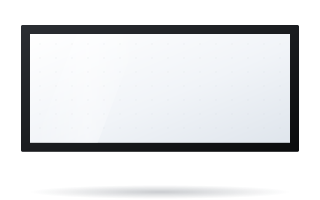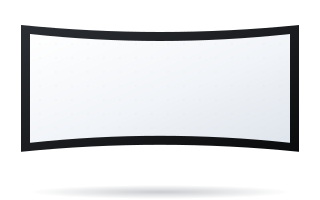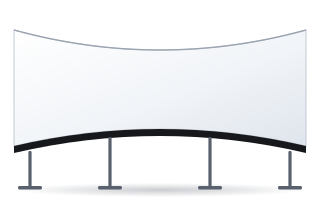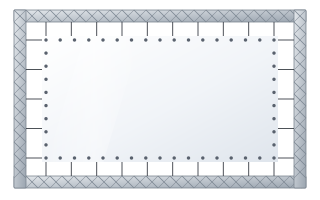
- Cinema and Cinema Curved are fixed-frame screens with an image width from 7 to 23 m, on an aluminium frame with structural bars every 4 or 5 m.
- The fabric covers the entire frame and attaches directly to it; at widths of 7–23 m it is welded vertically.
- Formats include 1.78:1, 1.89:1, 2.35:1, 2.37:1, 2.39:1 and 2.40:1.
- For commercial cinemas, theatres and large auditoriums the manufacturer specifies Vision Macro Acoustik fabric with 1.3 mm perforation.
- Calculate image size from the furthest viewer: image height approx. 1/6 of that distance, and the front row at least one image width from the screen.
Who Cinema screens are for
Cinema and Cinema Curved are fixed-frame screens for venues where the image is 7 to 23 m wide. These include art-house and commercial cinemas, auditoriums in arts centres, theatres with on-stage projection, conference halls and large AV installations. They are not home cinema screens. For the home, choose the smaller models in the fixed-frame and curved categories.
You will find both models in the cinema screens category. They differ in geometry: Cinema is flat, while Cinema Curved has a curved surface.
How a screen well over ten metres wide is built
- The frame consists of aluminium profiles. Structural bars are added every 4 or 5 m to stiffen the whole assembly.
- The fabric covers the entire frame and attaches directly to it. The manufacturer describes this as a new anchoring system that shortens installation.
- Vertical weld – at widths of 7–23 m the fabric is joined with a vertically running weld. Cinema Curved always has a vertical weld.
- The Cinema Curved mounting kit includes steel connectors and corners, wall brackets, braces, M8 bolts, elastic tensioners and fabric corners.
Because the fabric covers the frame, the edge of the image is not outlined by a profile. It is therefore worth planning a dark wall or masking drapes around the image. With well-tensioned fabric and the correct viewing distance, the weld is hard to notice. It is still worth knowing about before ordering, especially if you are designing a room with a very close front row.
Formats – flat, scope and caution with "DCI"
Cinema screens are available in 1.78:1, 1.89:1, 2.35:1, 2.37:1, 2.39:1 and 2.40:1. In cinema practice there are two groups:
| Group | Formats | When to choose |
|---|---|---|
| Narrower | 1.78:1 (16:9), 1.89:1 | multi-purpose room: films, conferences, live broadcasts, presentations |
| Wide (scope) | 2.35:1–2.40:1 | room focused mainly on feature films in widescreen format |
The 1.89:1 format is close to the 1.90:1 container used in digital cinema, but the manufacturer does not describe it as "DCI". If the cinema specification requires a particular standard, confirm the dimensions with the projector supplier. General principles for choosing proportions are covered in our guide 16:9 or 2.35 aspect ratio.
How to calculate image size in a cinema
The manufacturer gives a rule for professional venues: for video and presentations, image height is approx. 1/6 of the distance to the furthest viewer. The nearest viewer should sit at least one image width from the screen.
Example. A room measures 22 m from the screen to the back row.
- Image height: 22 ÷ 6 ≈ 3.67 m.
- Width at 2.39:1: 3.67 × 2.39 ≈ 8.77 m.
- Width at 1.89:1: 3.67 × 1.89 ≈ 6.94 m.
- Front row at 2.39:1: no closer than approx. 8.8 m from the screen.
Also check the upward viewing angle. According to the manufacturer, the angle from the viewer's eyes to the centre of the image should not exceed approx. 15°. This is easier to achieve with raked seating; in flat-floored rooms the height of the bottom edge is decisive. Detailed formulas can be found in our guide how to choose screen size.
Projector distance follows from its throw ratio: image width = projection distance ÷ throw ratio. For an 8.77 m image and a projector in a booth 25 m from the screen, you need a lens with a throw ratio of approx. 2.85.
Fabric for cinemas, theatres and auditoriums
In a cinema the speakers usually stand behind the screen, so the fabric must let sound through. The manufacturer specifies:
- Vision Macro Acoustik – gain 0.75, 1.3 mm perforation. Described in the catalogue as a fabric for commercial cinemas, theatres and very large auditoriums, with no hot-spot effect.
- Vision Acoustik – gain 0.75, 0.5 mm perforation. Intended for commercial venues other than cinemas.
- Reference White 2 Acoustik and Reference Grey 2 Acoustik – 0.5 mm perforation, for dark cinema rooms (white) or rooms with lighter walls (grey).
With Cinema Curved you can choose from the full list of fabrics, including non-perforated ones. With the flat Cinema you select the fabric during configuration. Larger perforation lets sound through better but is more visible close up. That is why 1.3 mm works where viewers sit far from the screen. More in our guide to acoustic screens.
Flat or curved
Cinema Curved curves the surface around the audience. With wide scope formats, curvature evens out the distance from the viewer to the centre and to the edges of the image and improves brightness uniformity across the full width. In return it requires a projector with geometry correction and more depth in the room. Details in our guide curved or flat screen.
Preparing the room for a large screen
- Walls and ceiling around the screen – dark, matt surfaces limit reflections that wash out blacks. This is standard in cinemas; in a multi-purpose room it is worth at least darkening the zone around the screen.
- Space for speakers – with an acoustic fabric, plan a structure behind the screen and the distance between the speakers and the fabric.
- Projector brightness – acoustic fabrics have a gain of 0.75, so they reflect less light than a white fabric with a gain of 1.2. For an image well over ten metres wide, the projector needs ample brightness headroom.
- Installation access – the frame is well over ten metres wide. Check that the components will fit through the doors and onto the stage, and where the lift platform will stand.
When to choose a different screen
- Multi-purpose room where the screen should disappear – the motorised Big One, 6–8.5 m wide, retracts into its case.
- Auditorium with an image up to 7 m wide – Frameless, Max One or Max Inceel. Comparison in our guide screens for auditoriums and lecture halls.
- Temporary screen for a stage or truss – the Easy surface, up to 10 m wide.
Fire safety and delivery
ADEO fabrics have B1, M1 or M2 fire ratings, depending on the type. In public buildings, check the required class before choosing a fabric – we cover this in our guide to fabric fire ratings. Installing a frame well over ten metres wide is a job for an experienced crew with equipment for working at height. You can check the screen price in the configurator. ABC Prezentacji also provides advice on preparing the site and ships at no extra transport cost – get in touch with us.
Frequently asked questions
How large can a Cinema screen be?
The image width of Cinema and Cinema Curved screens ranges from 7 to 23 m.
Does a 20 m wide cinema screen have a seam?
Yes. At widths of 7–23 m the fabric is welded vertically, and Cinema Curved always has a vertical weld. At the correct viewing distance it is hard to notice.
Which fabric should I use for a cinema with speakers behind the screen?
For commercial cinemas, theatres and large auditoriums the manufacturer specifies Vision Macro Acoustik with 1.3 mm perforation and a gain of 0.75. In smaller rooms, where viewers sit closer, fabrics with 0.5 mm perforation are used.
Is the Cinema screen available in DCI format?
The screen is available in formats including 1.89:1, close to the 1.90:1 container, but the manufacturer does not describe it as DCI. Confirm compliance with a specific cinema's requirements with the projector supplier.
Is Cinema suitable for a home cinema?
No. Cinema starts at an image width of 7 m and is intended for cinemas, theatres and auditoriums. For the home, choose fixed-frame screens such as Plano, Prestige or Frameless.