- ADEO acoustic fabrics have 0.5 mm micro-perforation (home cinema, corporate rooms) or 1.3 mm perforation (Vision Macro Acoustik – cinemas, theatres, large venues).
- Voices come from the centre of the image, not from below it or the side – that is the main benefit.
- Acoustic fabrics have a gain of 0.5 to 0.9, so the projector should have brightness in reserve.
- They work best on fixed-frame screens and tensioned motorised screens – the fabric must be flat, and space is needed behind it for the speakers.
What is an acoustic screen?
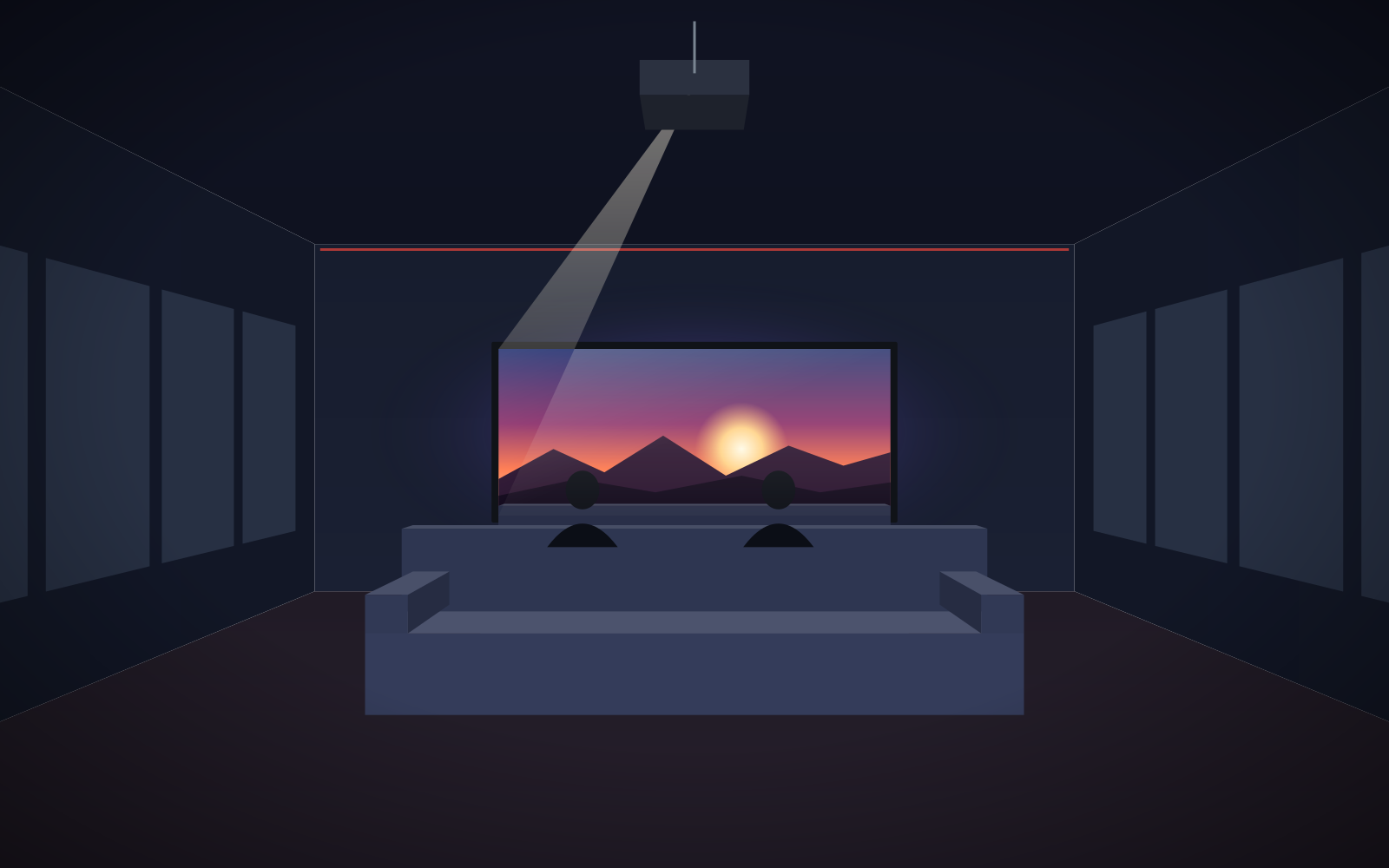
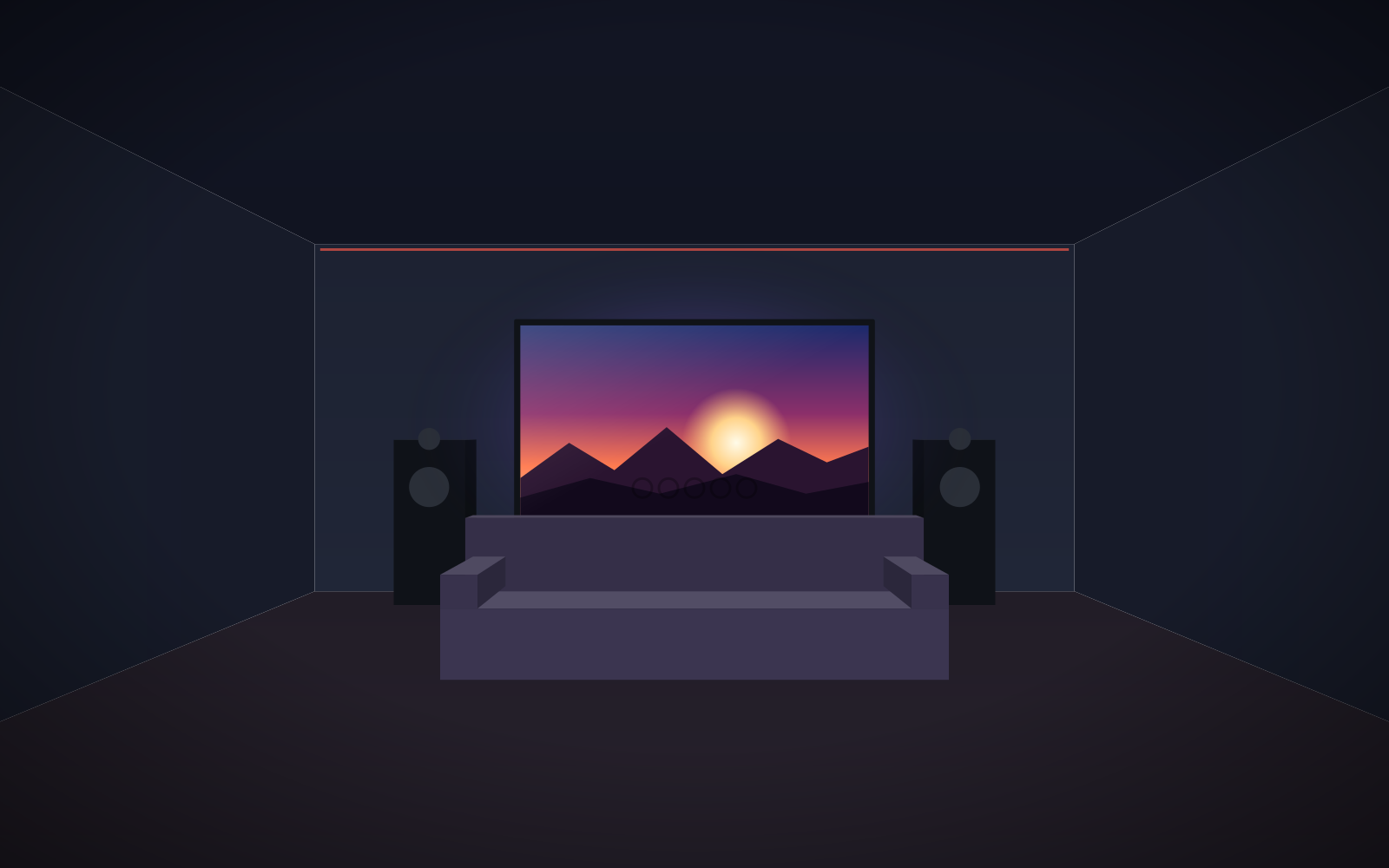
An acoustic (acoustically transparent) screen has a fabric with thousands of tiny holes. Sound from speakers behind the screen passes through the perforation, while the viewer sees a uniform image – the holes are not visible from a normal viewing distance. This is how cinemas are built: the centre channel and front speakers stand behind the screen, so dialogue “comes” from the actors' mouths and sound moves across the screen with the action.
In a home cinema without an acoustic screen, the centre speaker usually sits below or above the image. It is a compromise: the larger the screen, the more clearly you can hear that the voice comes from somewhere other than the face on screen.
0.5 mm or 1.3 mm perforation
ADEO uses two types of perforation. The choice depends mainly on how close to the screen the viewers sit and how large the image is.
| Fabric | Gain | Perforation | Use |
|---|---|---|---|
| Reference White 2 Acoustik | 0.9 | 0.5 mm | dedicated, dark cinema room |
| Reference Grey 2 Acoustik | 0.5 | 0.5 mm | cinema with light walls; UST-compatible |
| Ambient Grey 2 Acoustik | 0.8 | 0.5 mm | ALR + acoustics; standard and short-throw projectors only, not UST |
| Vision Acoustik | 0.75 | 0.5 mm | commercial venues other than cinemas, no hot-spot |
| Vision Macro Acoustik | 0.75 | 1.3 mm | cinemas, theatres, very large venues |
0.5 mm micro-perforation is intended for rooms where the front row sits a few metres from the screen – home cinemas, boardrooms, showrooms. The holes are small enough not to affect the sharpness of a 4K image.
1.3 mm perforation (Vision Macro Acoustik) lets more sound through and is intended for very large screens with viewers seated far away – cinemas, theatres, auditoriums. It is usually not needed in a home cinema room.
When an acoustic screen makes sense
- Dedicated cinema room – you have a front wall just for the screen and speakers, and the image is 2.5 m wide or more.
- The screen takes up the full width of the wall – there is no room for speakers at the sides, and a centre speaker below the screen would force the image too high.
- Aesthetics – you want the speakers to be completely invisible, e.g. in a living room with a permanent fixed-frame screen.
- Prestige rooms and showrooms – sound system hidden behind the image, with no speakers in view.
It is not worth it when the screen is a roller screen hanging in front of a window, wardrobe or shelving – you cannot put speakers behind the screen anyway. Nor is it worth it when the projector is not very bright and there is a lot of light in the room: acoustic fabrics have a gain below 1, so the image will be slightly darker than on Vision White (gain 1.2). More about this parameter under gain.
How to position speakers behind the screen
Speakers are placed behind the fabric, as centrally as possible for each channel (left, centre, right), with the tweeters at roughly 1/2–2/3 of the image height. Leave a gap between the front of the speaker and the fabric – usually a dozen or so centimetres or more, as recommended by the speaker manufacturer. Too small a gap can cause reflections from the fabric and vibration, and with roller screens – the fabric rubbing against the speaker grille.
It is worth lining the wall behind the screen and the space around the speakers with a dark, matt, sound-absorbing material. This reduces sound reflections and stops a light wall or a speaker logo showing through the perforation.
Effect of the fabric on sound
Every acoustic fabric slightly attenuates the highest frequencies. In practice the difference is corrected with the equaliser in the AV receiver or processor (many devices do this automatically during microphone calibration). Always calibrate with the screen installed, not before.
Moiré and image sharpness
Moiré is a wavy pattern that can appear when the regular grid of holes overlaps the projector's pixel grid. The risk increases when you sit very close to the screen and when the pixel size on the screen is similar to the perforation spacing. How to avoid it:
- choose 0.5 mm micro-perforation for a home cinema and leave 1.3 mm perforation for large venues;
- keep to the recommended distance – the nearest viewer at least 1 × the image width away;
- before ordering for a larger room, ask for a fabric sample and test it with your projector.
Image brightness on acoustic fabric
The gain of white acoustic fabrics is 0.9 (Reference White 2 Acoustik) or 0.75 (Vision Acoustik). Compared with Vision White at a gain of 1.2, the image on Vision Acoustik will be about 1/3 darker (0.75 / 1.2 ≈ 0.63, i.e. about 63% brightness). Grey Reference Grey 2 Acoustik (gain 0.5) needs a noticeably brighter projector, but holds blacks better with light walls. Take gain into account when choosing a projector – details in the guide screen gain and viewing angle.
Note one difference: the acoustic version of Ambient Grey 2 is not suitable for ultra-short-throw projectors (UST). If you have a UST projector and want speakers behind the screen, choose Reference Grey 2 Acoustik.
Which acoustic screen to choose
Acoustic fabric must be perfectly flat – ripples change the image geometry and the distance from the speaker to the fabric. That is why the best options are:
- Plano – a classic fixed-frame screen with a black velvet frame, image width 1.8–3 m, aspect ratios up to 2.40:1;
- Prestige – narrow frame of approx. 10 mm, width 2–4 m;
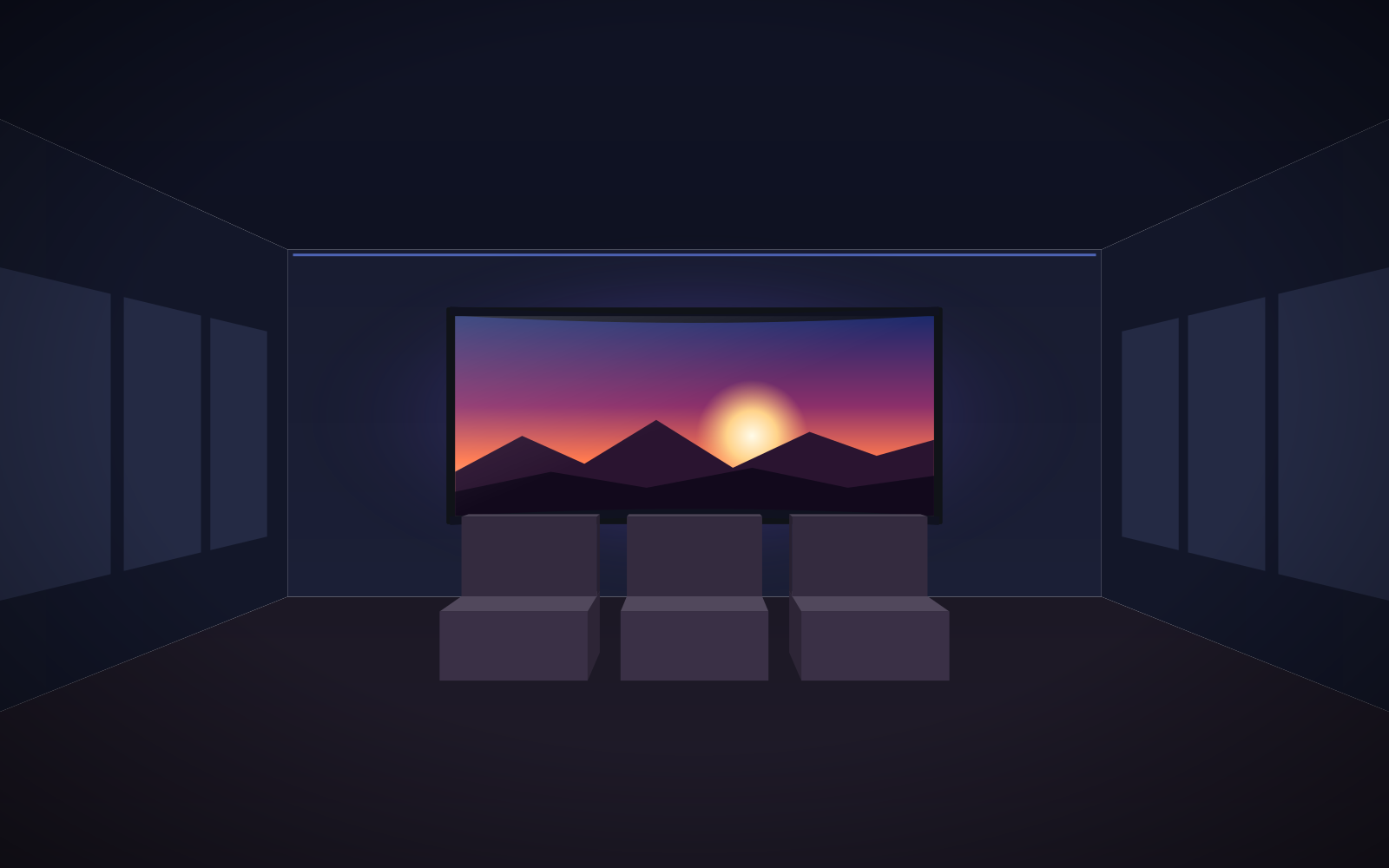
- Plano Curved – a curved fixed-frame screen, also with acoustic fabrics;
- OnSuperior and InSuperior – motorised screens with Floating Tab side tensioning, when the screen needs to retract into a case or the ceiling.
With a roller screen, remember the space: the fabric comes down in front of the speakers, so the case must stand far enough from the wall that the fabric does not touch them. Bracket extensions from the screen accessories section help with this.
Common mistakes
- Choosing 1.3 mm perforation for a small home room – the holes may be visible up close.
- Speakers pressed against the fabric, or a roller screen not moved away from the wall.
- A light wall or glossy grilles behind the screen – they show through the perforation.
- Calibrating the sound before the screen is installed.
- Ambient Grey 2 Acoustik with a UST projector.
Checklist before ordering
- Measure the depth of the space behind the screen and the depth of the speakers.
- Decide on the image width – the guide how to choose the screen size will help.
- Choose the fabric: white for a dark room, grey with light walls, ALR only with a standard projector.
- Check the projector brightness, taking the gain into account.
- Choose a fixed-frame or tensioned motorised screen and configure it in the configurator.
A full overview of surfaces is on the projection fabrics page.
Frequently asked questions
Does sound get worse through an acoustic screen?
The fabric slightly attenuates the highest frequencies. The difference is corrected with the equaliser in the AV receiver or processor, ideally during calibration with the screen installed.
Can you see the holes in acoustic fabric?
0.5 mm micro-perforation is invisible from a typical home cinema viewing distance. 1.3 mm perforation is designed for large venues where viewers sit far from the screen.
How far from the screen should the speakers be?
Leave at least a dozen or so centimetres between the speaker and the fabric, or as much as the speaker manufacturer recommends. The fabric must not touch the speakers.
Can an acoustic screen be motorised?
Yes – acoustic fabrics are available in, among others, OnSuperior, InSuperior and Rugby Plus. It is best to choose a tensioned version, because the fabric must be flat.
Is an acoustic screen suitable for a UST projector?
Yes, but with Reference Grey 2 Acoustik fabric. Ambient Grey 2 Acoustik is not designed for ultra-short-throw projectors.