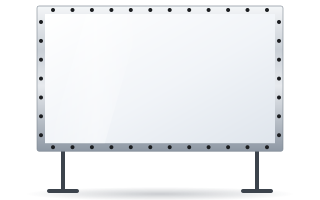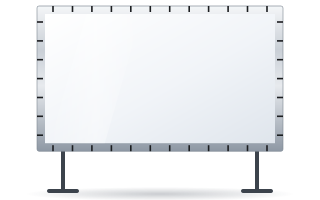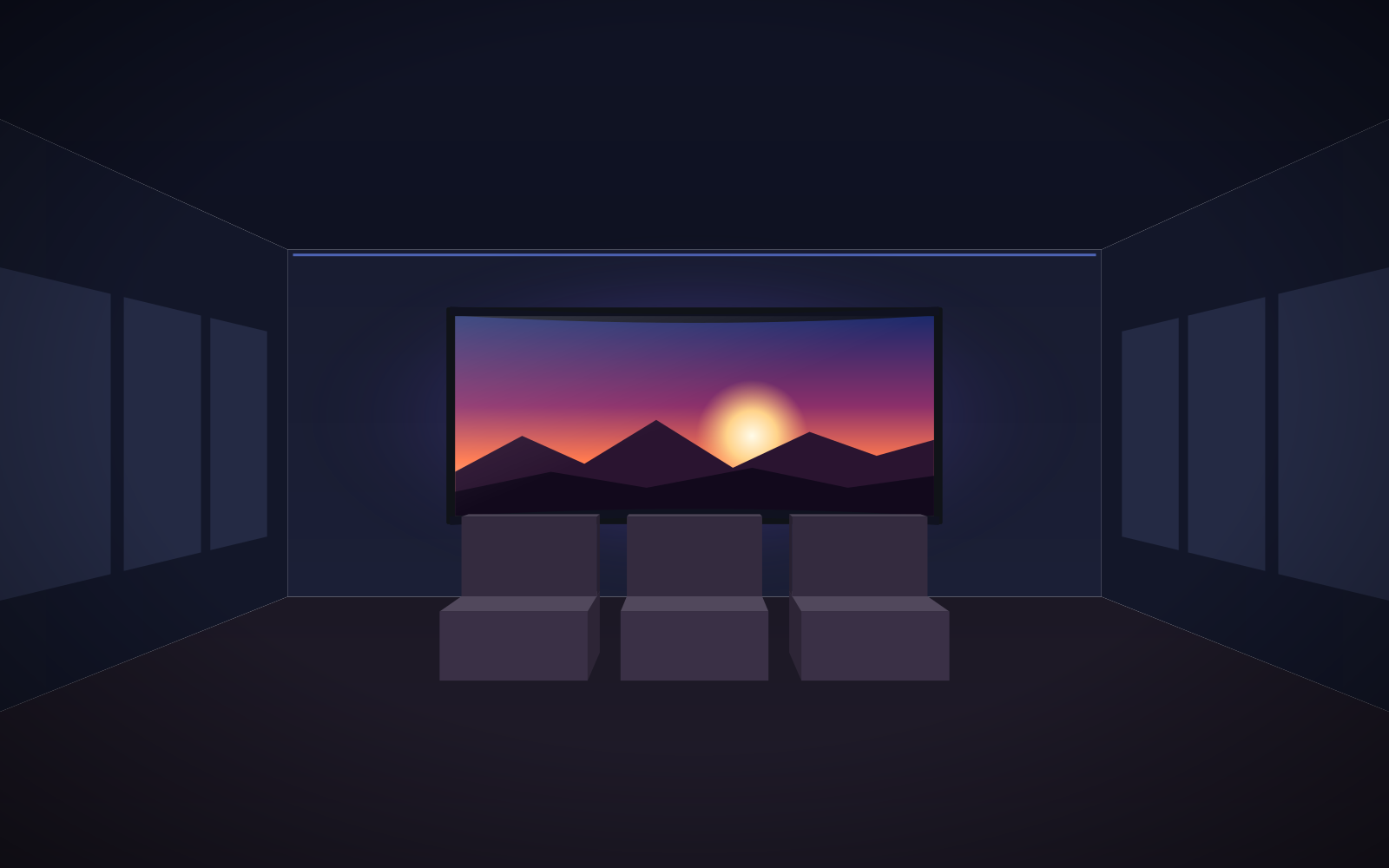
- Plano has a wide profile bevelled on the inside, finished in black lacquer or velvet (Velvet) – the frame absorbs any light that spills beyond the image.
- Prestige has an ultra-slim frame of approx. 10 × 6 mm and looks like a large TV; optional LED wall backlighting.
- Frameless hides a 108 × 32 mm profile under the fabric – all you see on the wall is the image.
- Width range: Plano 1.8–3 m, Prestige 2–4 m, Frameless 3–7 m.
- The slimmer the frame, the more precisely the projector must be aligned, as there is no black border to mask uneven image edges.
Why compare fixed-frame screens with each other
If you already know you want a fixed-frame rather than a roller screen, the main decision is behind you. We have gathered the arguments for and against in our guide fixed-frame or motorised screen. This article covers the next step: which frame model suits your interior and your projector.
All three models hold the fabric taut on a rigid frame, so the surface is flat and free of waves. They differ in what the frame looks like, how the fabric is tensioned and how the screen attaches to the wall.
Comparison at a glance
| Feature | Plano | Prestige | Frameless |
|---|---|---|---|
| Frame visible from the front | wide, black, profile bevelled on the inside | ultra-slim, approx. 10 × 6 mm, matt black | invisible – 108 × 32 mm profile under the fabric |
| Frame finish | black lacquer or velvet (Velvet version) | matt black, Black Flock option | covered with fabric |
| Fabric tensioning | elastic cords | springs | metal springs |
| Mounting | concealed bracket slotting into the back of the frame; optional floor legs | wall brackets | magnetic kit, screen flush with the wall |
| Image width in the shop | 1800–3000 mm | 2000–4000 mm | 3000–7000 mm |
| Aspect ratios | 4:3 to 2.40:1 | 4:3 to 2.40:1 | 4:3 to 2.40:1 |
| Curved version | Plano Curved | – | Frameless Curved |
Plano – the home cinema classic
Plano is a screen the manufacturer aims primarily at home cinemas. The aluminium profile is bevelled on the inside. As a result, light reflected off the edge of the frame is directed outwards rather than back into the image and towards the audience.
The frame can be ordered in black lacquer or in the Velvet version, covered in black velvet (flock). Velvet absorbs light. If the projector throws an image slightly larger than the surface or uses a little geometry correction, the overspill disappears into the frame and the edge of the image stays sharp. It is the safest choice when the projector has no lens shift or sits slightly off-axis.
The fabric is tensioned with elastic cords. The wall bracket slots into the back of the frame and is invisible, and the frame sits flat against the wall. Adjustable floor legs (height 152–284 cm) and a ceiling-mount bracket are available for Plano. Plano supports the full range of fabrics, including acoustic and ALR.
Prestige – the look of a big TV
Prestige has a frame with a cross-section of approx. 10 × 6 mm in matt black. From a distance it resembles an LED or OLED TV hanging on the wall, only several times larger. It is a good choice for a living room where the screen hangs permanently and should look modern rather than like part of a cinema room.
The fabric is spring-tensioned. Optionally, you can add LED wall backlighting behind the screen for a colour accent, as well as a Black Flock finish. Image width ranges from 2 to 4 m, and the fabric list also includes Vision Macro Acoustik with 1.3 mm perforation.
The narrow frame has one practical consequence. There is little margin for imprecise projector alignment. The image has to hit the surface almost to the centimetre.
Frameless – just the image on the wall
In Frameless the 108 × 32 mm aluminium profile is completely hidden under the fabric, which is held by metal springs. A magnetic kit lets you hang the screen flush with the wall. The result is a uniform surface with no surround.
The manufacturer gives two application ranges: at home up to approx. 4 m wide, and in professional venues such as hotels and conference rooms up to a 7 m base. In our shop Frameless is configured in the 3–7 m range, so it is really a model for large walls. For smaller sizes, Plano and Prestige are a better fit.
Without a black border, all the edge contrast depends on the precision of projector alignment and on the colour of the surrounding wall. On a light wall the boundary of the image is less distinct than on a dark one. In a dedicated cinema room with dark walls this problem disappears.
How to choose – three questions
- Can the projector be aligned perfectly? If you have lens shift and can place the projector on-axis, choose any model. If not, Plano with a velvet frame is the safer option.
- How big should the image be? Up to 3 m all of them work, but Frameless starts at 3 m. Above 4 m, Frameless is the only option. How to calculate the size is explained in our guide how to choose screen size.
- What should the interior look like? Cinema room – Plano Velvet. Living room in a "TV on the wall" style – Prestige. Minimalist wall, reception, showroom or museum – Frameless.
Fabrics and UST projectors
All three models support a wide range of fabrics, including acoustic ones (we cover speakers behind the screen in our guide to acoustic screens) and grey ALR. A fixed-frame screen is the recommended solution for ultra-short-throw projectors, because projection at a steep angle accentuates every wave in the fabric. For UST, choose Reference Grey 2 or Ambient Grey. Ambient Grey 2 and its acoustic version are not intended for UST. More in our guide to screens for UST projectors.
Wall colour and the screen's surroundings
A fixed-frame screen hangs permanently, so it is worth thinking right away about what surrounds it. A light wall around the image reflects light from the projector and the room, making blacks on screen look grey. The wide velvet frame of the Plano partly isolates the image from this. With Prestige and Frameless the effect is stronger, as there is no black band between the image and the wall. If you cannot paint the wall a dark colour, consider a grey fabric such as Reference Grey 2. The manufacturer recommends it for rooms with light walls and a little ambient light.
Mounting accessories
- Wall brackets for Frameless and Prestige – a set of two brackets for screens up to 3500 mm wide.
- Adjustable legs for fixed-frame screens – for Plano and FramePro, with rings for attaching the frame.
- Ceiling bracket – for Plano, when the screen is to hang below the ceiling rather than on a wall.
Installing a fixed-frame screen requires no power, but it does require precision. The frame must hang perfectly level, as any deviation shows at the edge of the image.
Or perhaps a curved version
Plano and Frameless have curved variants: Plano Curved (1.8–4 m) and Frameless Curved (2–6 m). Curvature helps with wide cinema formats and front rows close to the screen. We discuss the pros and cons in our guide curved or flat screen.
Step-by-step frame installation is described in our guide to installing a fixed-frame screen. You will find all models in the fixed-frame screens category, and you can check the price of a specific size and fabric in the configurator.
Frequently asked questions
Which ADEO fixed-frame screen has the slimmest frame?
Prestige – the frame has a cross-section of approx. 10 × 6 mm. Frameless has no visible frame at all, because the profile is hidden under the fabric.
What is Plano Velvet?
It is the Plano version with a frame covered in black velvet (flock). The velvet absorbs light falling outside the image, so the image edge is sharp and the frame does not reflect light.
Is Frameless suitable for a living room?
Yes, the manufacturer intends it for homes up to approx. 4 m wide. In our shop Frameless starts at an image width of 3 m, so it suits large walls.
Which fixed-frame screen should I choose if my projector has no lens shift?
Plano with a wide velvet frame is the safest option. It absorbs image overspill and masks small alignment inaccuracies that cannot be hidden with Prestige or Frameless.
Can a fixed-frame screen stand on the floor?
Adjustable floor legs with a height of 152–284 cm are available for Plano. Prestige and Frameless are wall-mounted.