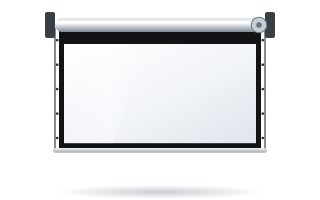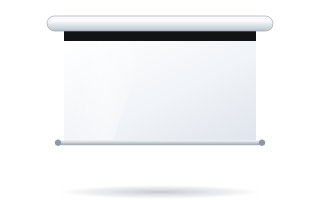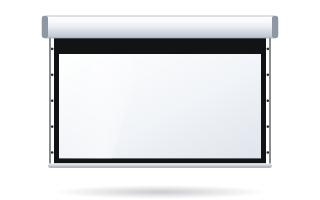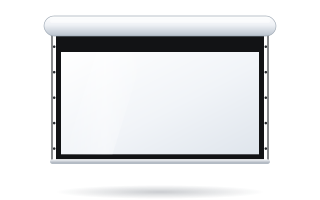
- The Basic is an economical screen with a wide size range (2000–6500 mm) and the full range of fabrics, including a Tensio tensioned version.
- The Basic has no case – the roller with the motor is fixed with side brackets, which works well in recesses, behind beams and in built-in installations.
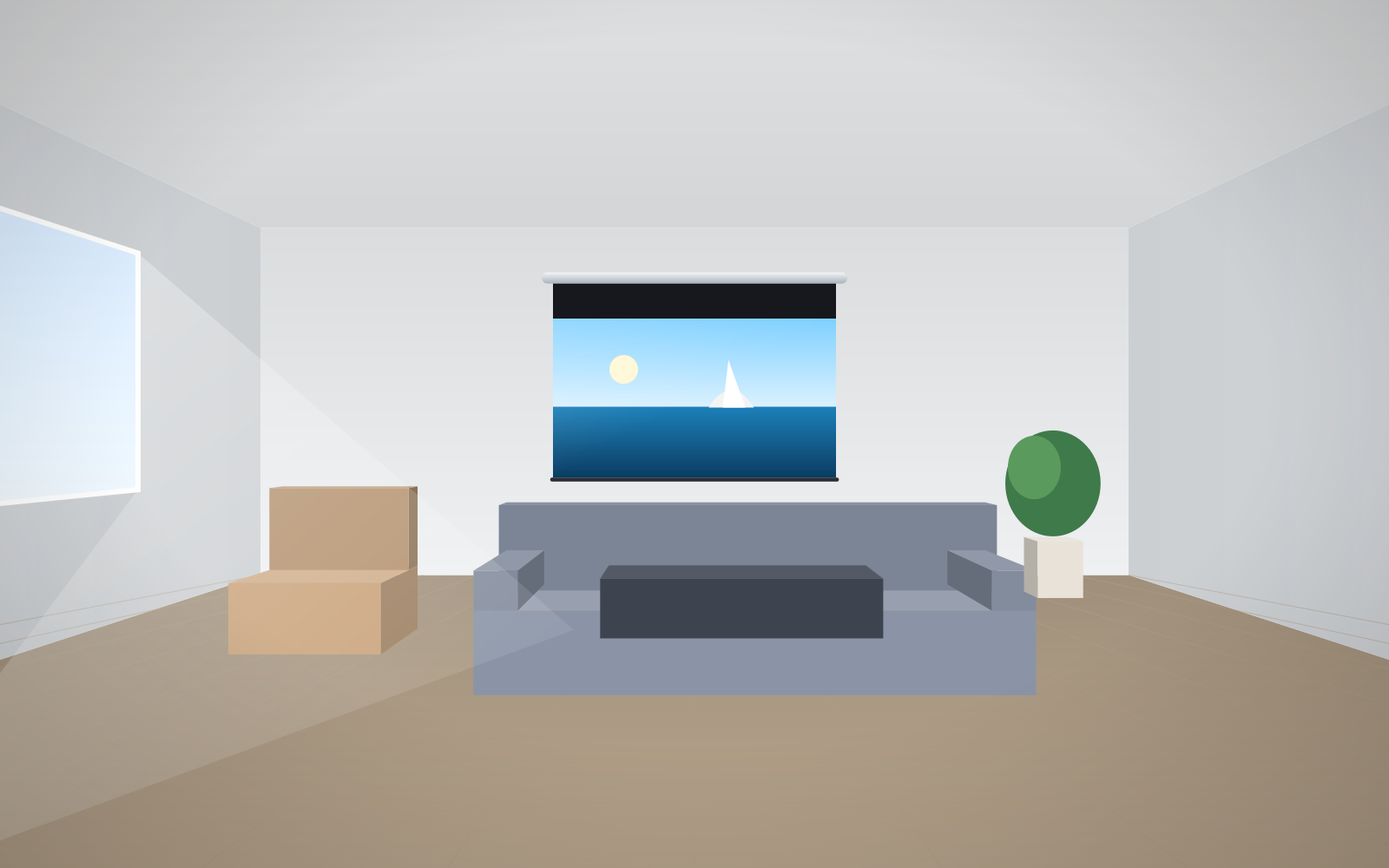
- The Linear SE has a slim case of approx. 79 × 118 mm and suits living rooms, studies and small rooms.
- The Linear SE is mounted against a wall – it is not designed to hang from the middle of a ceiling.
- Choose a Rugby when the screen is used heavily, quiet operation matters or you need acoustic fabrics in smaller sizes.
Who the Basic and Linear SE are for
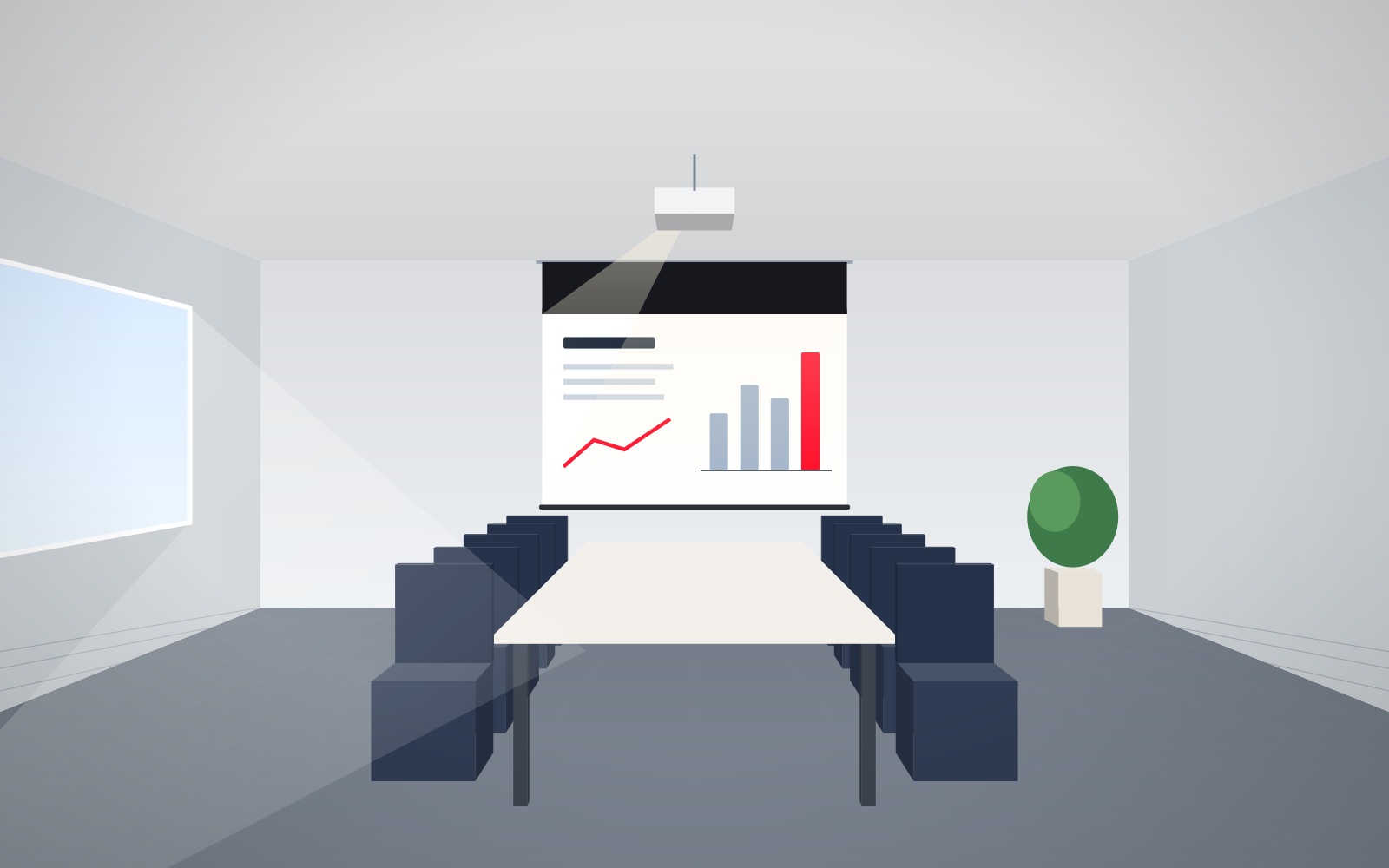
Not every room needs a screen with an elaborate tensioning system or a recessed case. In a classroom, training room, small meeting room or media room, what usually matters is a simple motorised screen that reliably lowers at the touch of a switch or remote. For these applications ADEO offers two models:
- Basic – an economical motorised screen with a very wide size range and a large choice of fabrics,
- Linear SE – a screen with a slim, minimalist case that looks good in a living room, study or small meeting room.
Both are made to measure, and you see the price of a given configuration immediately in the Configurator. Other models are in the motorised screens category.
Basic and Linear SE in figures
| Feature | Basic | Linear SE |
|---|---|---|
| Image width | 2000–6500 mm | 1800–4000 mm |
| Aspect ratios | 1:1, 4:3, 16:10, 16:9, 2.35:1, 2.40:1 | 1:1, 4:3, 16:10, 16:9 |
| Finishes | no borders, 5 or 7 cm black borders, Tensio versions | no borders |
| Fabrics | full range: white, grey, ALR, acoustic, Vision Rear DB, ChromaKey | Vision White, Vision White Pro (temporarily unavailable), Vision Rear DB, ChromaKey |
| Case | none – roller with motor on side brackets, white bottom bar | slim, approx. 79 × 118 mm, white or matt black |
| Motor | 230 V tubular, wall switch; optional io-homecontrol motor with remote (up to 4500 mm) | 230 V tubular; on the right as standard |
| Installation | wall or ceiling | against a wall (not in the middle of a ceiling) |
Basic – a screen for classrooms, training rooms and recesses
The Basic is ADEO's most versatile economical model. It has a 230 V tubular motor operated by a wall switch, with an optional io-homecontrol motor featuring an integrated radio receiver and remote – available up to an image width of 4500 mm. The motor is on the right as standard, but you can order it on the left, front roll, Reverse Roll, a black bottom bar and a RAL colour.
A caseless screen
The manufacturer describes the Basic as an integrated motorised screen without a case, intended for professional installations. The roller with the fabric is fixed with side brackets to a wall or ceiling. It works best where the screen will be hidden anyway: in a recess, behind a beam, in built-in furniture or in a tight space. If the rolled-up screen should be protected by a case, choose the Rugby Pro, Rugby Plus or Linear SE.
Basic with tensioning
The Basic is also available in a tensioned (Tensio) version. In this series the manufacturer describes the CTS system – counterweights at the ends of the bottom bar pull taut cables, maintaining constant side tension. This matters if you want to use a grey ALR fabric: roller screens with ALR fabric need to be flat, so it is not worth choosing one without tensioning. Read more in our guide tensioned Tensio screens.
Large sizes on a sensible budget
With image widths of up to 6500 mm, the Basic also works in larger lecture theatres and sports halls. For the furthest rows, apply the manufacturer's rule: image height should be at least 1/6 of the distance to the last viewer. At 12 m that gives a height of 2 m, i.e. a width of 3.2 m at 16:10.
Linear SE – a slim case for smaller interiors
The Linear SE looks discreet: the case has a cross-section of approx. 79 × 118 mm and can optionally be matt black – which goes well with a dark ceiling or wall. As standard the fabric rolls out from the back of the case, with front roll and Reverse Roll available as options.
The manufacturer designs the Linear SE for professional installations, schools and small meeting rooms, and notes that the model is mounted against a wall only – it is not intended to be suspended from the middle of a ceiling. If the screen needs to hang away from the wall, choose the Basic or Rugby.
The Linear SE offers four surfaces:
- Vision White (gain 1.2) – a versatile white for darkened and semi-darkened rooms,
- Vision White Pro (temporarily unavailable) (gain 0.9) – with a black back that blocks light from behind the screen,
- Vision Rear DB – for front or rear projection, described in our guide rear projection,
- ChromaKey Green RAL 6038 – a backdrop for filming, not a projection surface; more in our guide ChromaKey green screens.
Installation and control in practice
Both models run on 230 V – have an electrician connect the motor and decide in advance which side the cable should come out on. On the Basic you can choose the motor on the left if that is closer to the power outlet. Standard control is a wall switch. In a classroom that is usually enough, but if the teacher is to operate the screen from the desk, consider a motor with a radio remote. Before installation, also check that the lowered screen will not cover the board, a window or sockets used during lessons.
Limitations worth knowing about
- The Linear SE has no grey, ALR or acoustic fabrics. For a bright living room or a room with speakers behind the screen, choose another model.
- The Linear SE has no version with black borders or tensioning – with an ultra-short-throw projector a tensioned or fixed-frame screen is a better choice.
- The Basic without tensioning is a classic roller screen. For large sizes and high resolution, consider the Tensio version.
- The 2.35–2.40:1 cinema formats are offered only on the Basic.
When to choose a Rugby
The Rugby series is a step up and worth considering when:
- the screen is used daily in a conference room – the Rugby Pro has steel end caps and bottom bar, plus a case with a snap-fit system that limits motor vibration,
- quiet operation at home matters – the Rugby Plus has noise-reducing features and a bottom bar with soft seals,
- you need the Reference White 2 Acoustik or Reference Grey 2 Acoustik fabrics – the Rugby Plus offers them,
- you want a small screen – the Rugby starts at a width of 1580 mm.
The differences between the two Rugby versions are covered in our guide Rugby Plus or Rugby Pro.
Which model to choose – summary
| Situation | Recommendation |
|---|---|
| Classroom or training room, white fabric, budget comes first | Basic |
| Very wide room, image over 4 m | Basic |
| Screen in a recess or behind a beam | Basic (caseless, on side brackets) |
| Living room, study, small meeting room, the look of the case matters | Linear SE |
| Recording set-up with a green backdrop | Linear SE or Basic with ChromaKey fabric |
| ALR fabric | Basic Tensio or other tensioned models |
| Heavy use, boardroom, home cinema | Rugby Pro or Rugby Plus |
For help choosing a school screen, see our guide screens for schools.
Frequently asked questions
How does the Basic differ from the Linear SE?
The Basic has a wider size range (2000–6500 mm), more aspect ratios, the full range of fabrics and versions with borders and tensioning. The Linear SE has a slim case of approx. 79 × 118 mm and four fabrics: Vision White, Vision White Pro (temporarily unavailable), Vision Rear DB and ChromaKey.
Can the Linear SE hang from the middle of a ceiling?
No. The manufacturer designs the Linear SE for wall-adjacent mounting only. For suspension away from the wall, choose the Basic or Rugby.
Does the Basic have a case?
No. The Basic is a caseless screen – the roller with the motor is fixed with side brackets. If you want the rolled-up screen hidden in a case, choose the Rugby Pro, Rugby Plus or Linear SE.
Can ALR fabric be used on the Basic?
Yes, but roller screens with ALR fabric need to be flat, so choose the Basic with Tensio tensioning.
Do the Basic and Linear SE come with a remote?
The Basic can be ordered with an io-homecontrol motor and radio remote (up to an image width of 4500 mm). You can set the Linear SE control in the Configurator; a wall switch is standard.