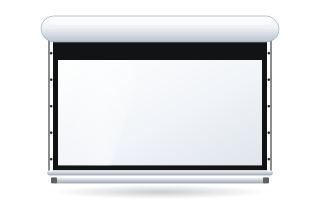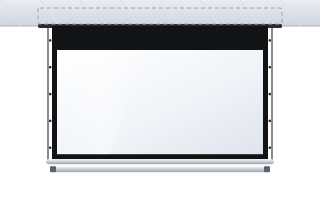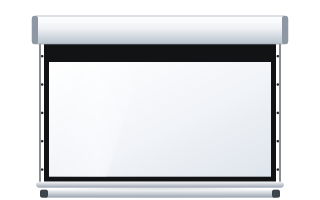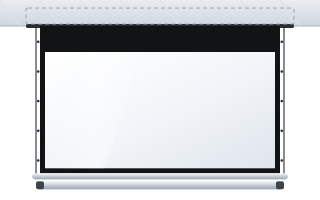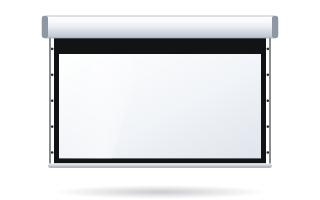
- Roller fabric is tensioned mainly vertically by the weight bar – nothing pulls it sideways, hence possible waves at the edges.
- Tensioning systems add horizontal tension: with side cables (Tensio Classic, CTS) or a double bar with weights (Floating Tensio, MFTS).
- Tensioning is recommended for ALR fabrics, UST projectors, 4K resolution and large widths.
- ADEO tensioned screens include OnSuperior, InSuperior, Max One, Max Inceel and the Tensio versions of Rugby, Inceel, Basic and Alumid.
Why the fabric of a roller screen can ripple
In a motorised screen the fabric is wound onto a roller and unrolled downwards. It is tensioned by the weight of the bottom bar – but this acts mainly vertically. Nothing pulls the sides of the fabric, so slight vertical waves can appear at the edges, and local bulges in the middle. The causes are typical of any rolled material:
- roll memory – fabric stored on a roller for a long time “remembers” the curvature,
- edges thicker than the centre – hemming or a border on the fabric increases the roll diameter at the edges,
- changes in temperature and humidity – the material moves slightly,
- large width – the wider the screen, the harder it is to keep even tension with the weight bar alone.
ADEO limits this effect even on standard screens: the fabric is fixed at the ends with two springs that compensate for its expansion, the roller has a double groove that prevents horizontal marks, and the border edges are high-frequency welded rather than painted. In many applications this is enough. There are, however, situations in which even a slight wave becomes visible.
When ripples are visible and when they are not
Unevenness in the fabric changes the angle at which light is reflected towards the viewer. On a wide-angle white fabric, with the projector hung square to the screen, small ripples are practically unnoticeable. They become visible when:
- light strikes the screen at a steep angle – as with UST projectors, which stand a few dozen centimetres from the wall and shine almost parallel to the fabric,
- the fabric reflects light directionally – as with ALR fabrics (Ambient Grey 2), whose structure is designed to reflect projector light towards the viewer and suppress light from other directions,
- the image has lots of detail and bright, uniform backgrounds – 4K content, sport, presentations with white backgrounds,
- side light from a window or lamps moves across the unevenness and casts shadows on it.
The manufacturer's recommendation is explicit: roller screens with ALR fabric need flatness, so they should have Tensio tensioning, or a fixed-frame screen should be chosen. UST projectors strongly accentuate fabric ripples, so they too call for a frame or Tensio.
How tensioning works – ADEO systems
All systems add horizontal tension to the vertical tension, but they do it in different ways.
| System | Operating principle | Features |
|---|---|---|
| Tensio Classic | two elastic cords run from the weight bar through eyelets on the sides of the fabric | a simple, proven system; the cords tension the fabric sideways over its full height |
| CTS (Constant Tensio System) | hinged counterweights pull rigid cables through eyelets | constant self-tensioning; eyelets bonded, invisible from the front |
| Floating Tensio (FTS, Floating Tab) | a double bottom bar with two weights and cables: one weight tensions the fabric vertically, the other with the cables – horizontally | separate vertical and horizontal tensioning; a flat surface also with ALR and acoustic fabrics |
| MFTS (Max Floating Tensio) | the same principle as Floating Tensio | the version for the largest formats |
For comparison: on fixed-frame screens the fabric has rods in its hem that are fixed with elastic cords to a rigid frame, so the tension acts evenly around the whole perimeter. Tensioned screens come close to this effect while keeping the ability to roll up.
Which ADEO models have tensioning
| Model | Type | Tensioning | Image width |
|---|---|---|---|
| OnSuperior | motorised, wall or ceiling case | Floating Tab | 2–4.5 m |
| InSuperior | in-ceiling | Floating Tab | 2–4.5 m |
| Max One | large-format | Floating Tab | approx. 4.6–6.5 m |
| Max Inceel | large-format in-ceiling | Floating Tab | approx. 4.7–6.5 m |
| Rugby Pro, Rugby Plus | motorised | Tensio Classic version | approx. 1.6–4.5 m |
| Inceel | in-ceiling | Tensio Classic version | 1.8–4 m |
| Basic, Alumid | motorised | Tensio version | Basic 2–6.5 m, Alumid 3.5–4.5 m |
OnSuperior and InSuperior have a 5 cm black or white border and are available with ALR and acoustic fabrics, including Ambient Grey 2, Reference Grey 2 and Reference White 2 Acoustik. All models are gathered in the tensioned screens category.
When tensioning is needed
- ALR fabric. Ambient Grey 2 in a roller screen – always with tensioning.
- UST projector. A roller screen without tensioning is not recommended; with tensioning, choose Reference Grey 2 or Ambient Grey fabric (not Ambient Grey 2).
- 4K resolution and home cinema in the living room. When the screen should disappear after viewing but the image should look as if it were on a frame.
- Large widths. The wider the screen, the greater the benefit of side tension – which is why the large-format Max One and Max Inceel have Floating Tab.
- Prestigious rooms. Boardrooms, council chambers, showrooms – wherever any unevenness shows on bright slides.
- Acoustic fabrics in a roller screen. Perforated fabric with speakers behind it should be evenly tensioned.
When an ordinary roller screen is enough
- A classroom, lab or training room with a standard projector and white Vision White fabric.
- A small screen in an office or room where the image is viewed mainly head-on.
- Occasional projection where simplicity is the priority.
For such applications, Basic or Rugby Pro in the standard version are a good choice.
Tensio or a fixed-frame screen
A frame gives the flattest surface and needs no power, but it is visible all the time. A tensioned screen comes close to a frame in flatness and disappears after use – into a case on the wall or into a suspended ceiling. If the screen is going into a dedicated cinema room, choose a frame; if it is going into a living room or multi-purpose room, choose Tensio. Full comparison: fixed-frame or motorised screen.
Installing and using a tensioned screen
- Install the case perfectly level. With side tensioning, a tilted case will quickly show up as diagonal ripples.
- Leave space at the sides. The cables and tensioning components work at the edges of the fabric – don't push the screen up against built-in units or curtains.
- Don't pull the fabric by hand. The tension is set by the system – adjusting it by hand can permanently deform the material.
- Plan in-ceiling installation in advance. InSuperior and Max Inceel need a recess in a suspended ceiling – see in-ceiling screens.
- Give the fabric time after first unrolling. New fabric rolled up for transport may need a while to settle.
Brackets and extensions for installation can be found in the screen accessories section, and general principles in the guide installing a motorised screen.
Common mistakes
- ALR fabric in a roller screen without tensioning – in this case the manufacturer recommends Tensio or a frame.
- Tensioning with Ambient Grey 2 for a UST projector – flatness is not everything; this fabric is not designed for UST.
- Expecting frame-like flatness from an ordinary roller screen – with 4K and bright backgrounds the difference is visible.
- A crooked case – no tensioning system can compensate for skewed installation.
Check the tensioned models in the configurator for the home or for business. The term is also explained in the glossary: Tensio.
Frequently asked questions
What is a Tensio screen?
It is a roller screen with side tensioning which, in addition to the weight bar, also tensions the fabric horizontally. The surface is therefore flat, close to that of a fixed-frame screen.
Why does a projection screen ripple?
Roller fabric is tensioned mainly vertically by the weight bar, and nothing pulls it sideways. Roll memory, thicker edges and temperature changes can then cause waves at the edges.
Is a tensioned screen necessary for a UST projector?
For UST projectors the manufacturer recommends a fixed-frame screen or a tensioned roller screen, with Reference Grey 2 or Ambient Grey fabric. An ordinary roller screen will accentuate every ripple.
What is the difference between Tensio Classic and Floating Tensio?
In Tensio Classic, two elastic cords run from the weight bar through eyelets on the sides. Floating Tensio has a double bottom bar with two weights – one tensions the fabric vertically, the other with cables horizontally.
Can a tensioned screen be hidden in the ceiling?
Yes. InSuperior and Max Inceel are in-ceiling screens with Floating Tab tensioning, and Inceel is available in a Tensio Classic version.