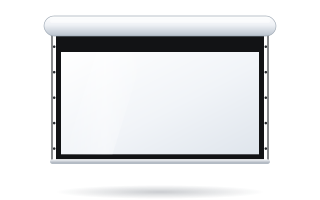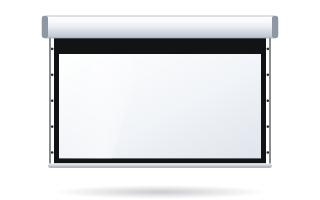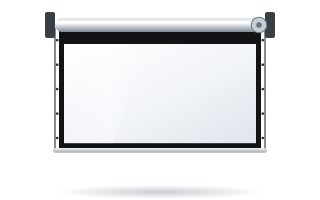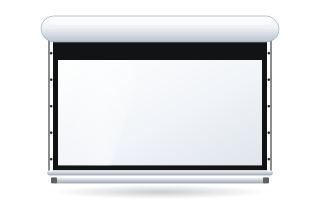
- A double-groove roller holds the fabric so that no horizontal marks form; its diameter is 60–150 mm depending on model and size.
- Two springs at the bottom bar compensate for the fabric expanding and contracting, which limits wrinkles.
- The fabric edges and black borders are high-frequency welded, not painted.
- A tubular motor runs inside the roller, and rubber components damp vibration and noise.
- Every roller screen is checked and adjusted on a test bench after assembly.
The main components of a motorised screen
A motorised screen consists of several sub-assemblies that work together every time it rolls down and up:
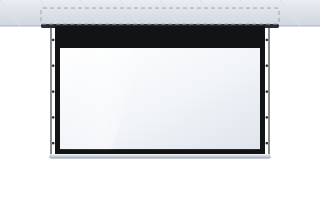
- case – an aluminium housing that protects the roller with the fabric and the motor, and is used to mount the screen on a wall or ceiling;
- roller – the tube onto which the fabric winds;
- tubular motor – hidden inside the roller, it turns it in both directions;
- projection fabric – the surface the image falls on, often with black borders at the sides and a black band at the top;
- bottom bar (weight bar) – straightens the fabric and, on many models, closes the case when rolled up;
- mounting brackets – connect the case to the wall or ceiling.
You will find the same layout in the entry-level Basic model as well as in models for conference rooms or in-ceiling installation. They differ in how individual components are made, the roller diameter and extras such as tensioning or noise damping.
The double-groove roller – why it matters
The most common flaw of cheap roller screens is horizontal lines visible on the image. They appear when the edge of the fabric attached to the roller presses into the successive layers of wound material. In all its screens ADEO uses a double-groove roller, which prevents such marks, plus an additional process that eliminates gaps where the fabric is attached to the roller.
Roller diameter matters too. The manufacturer matches it to the fabric size, in the range of 60 to 150 mm. A larger diameter means less curvature of the fabric when winding and less sag of a long roller under its own weight. A few examples from the manufacturer's documentation:
| Model | Roller diameter |
|---|---|
| Rugby (Plus and Pro) | 61 or 90 mm; 90 mm for widths above 2500 up to 4500 mm |
| OnSuperior | 90 or 120 mm |
| Alumid (non-tensioned version) | 108 mm, aluminium |
That is why, for large widths, it is worth choosing models designed for bigger formats rather than stretching a small screen to its limits.
Fabric: embossed surface and welded edges
ADEO fabrics have an embossed surface, compatible with 4K Ultra HD resolution. The fabric edges and black borders are high-frequency welded on all four sides rather than painted. This gives a sharp, even image edge, and the matt black border absorbs light that spills beyond the image and reduces reflections.
Springs and the bottom bar – fighting waves
Fabric changes dimensions with temperature and humidity. If it is rigidly screwed to the bar, wrinkles form as the material expands. In ADEO screens, the fabric connects to the bottom bar via two springs at its ends. The springs compensate for the material expanding and contracting and help keep the surface free of wrinkles.
On models such as Rugby, Inceel, InSuperior and OnSuperior, the bottom bar closes the case when rolled up. The fabric is then hidden and protected from dust, which matters in rooms where the screen hangs rolled up for months.
The weight of the bar alone is not always enough to keep the fabric perfectly flat, especially with ALR fabrics, ultra-short-throw projectors and large sizes. In those cases side tensioning is used – we describe it in our guide to Tensio tensioned screens.
Tubular motor and quiet operation
The motor of an ADEO screen is tubular, meaning it sits inside the roller. A rubber plate between the motor and the sides of the case damps vibration and noise, and rubber adapters at the ends of the motor have carefully chosen flexibility so that the motor does not shift. The motor runs on 230 V – it should be connected by a qualified electrician.
The motor has limit switches that stop the fabric in the unrolled and rolled-up positions. As standard the motor is fitted on the right; on many models the left side can be ordered, which makes it easier to match existing wiring. Control methods – from a wall switch to a radio remote and a projector trigger – are described in our guide to controlling a motorised screen.
Different cases – Rugby Plus and Rugby Pro as an example
The same design concept can be executed in different ways, depending on what the screen is for. The Rugby series shows this well:
| Component | Rugby Plus | Rugby Pro |
|---|---|---|
| Side end caps | milled aluminium, two-piece, joined with magnets | laminated steel |
| Bottom bar | with automatic lock and soft seals (Softend) | steel, built for durability |
| Noise damping | rubber bushings between the case and the roller (Quiet Rolling) | case with a snap-fit system that limits motor vibration |
| Closed position | a micro-switch always stops the bar in the same place (Auto Adjustment) | – |
| Intended use (manufacturer) | homes and residences | commercial installations |
You will find a detailed comparison in our guide Rugby Plus or Rugby Pro.
Case and mounting system
The case is more than a housing. Its rigidity determines whether a long roller runs true and whether the fabric winds evenly. The manufacturer uses several case sizes, including 103 and 119 mm, and much larger ones on large-format models. For example, Linear SE has a slim case of approx. 79 × 118 mm, Rugby Pro approx. 100 × 120 mm, and Alumid approx. 152 × 142 mm.
The case is fixed to the wall or ceiling in one of two ways. In standard mounting, the load-bearing element is screwed to the bracket and hooked onto the case profile, and the position is set with a plastic key and locked with a nut. Quick mounting uses a single bracket with hooks and a screw lock – the nut is partly tightened, the case is levelled, and only then is it locked. On the Rugby series the manufacturer uses the SuperQuick bracket: a symmetrical clamp made of an aluminium profile and a PVC block, which lets you fix the case from the front or back, on a wall or ceiling.
Factory quality control
ADEO screens are made at the factory in Złotoryja. The fabric is designed in a CAD system and plotter-cut to the dimensions of the order. Production software tracks every screen through all stages, and each stage is supervised by a technician. After assembly every roller screen goes to a test bench, where it is adjusted and checked. The packaging is designed for the specific model so that the screen arrives undamaged. Every screen carries a CE declaration.
What this means when choosing a screen
- For a room where the screen is used daily, choose a model with a bottom bar that closes the case and sturdy end caps.
- Where quietness matters – home cinema, lecture hall – look for noise-damping features.
- For large widths, choose models with a larger roller diameter, designed for such formats.
- When flatness is critical, choose a tensioned version or a fixed-frame screen.
- Make sure installation is correct – a crooked case is the most common cause of uneven winding; see screen installation mistakes.
You will find all motorised screens in the motorised screens category, and you can check the price of your configuration straight away in the configurator.
Frequently asked questions
Why do some roller screens show horizontal lines?
Most often these are marks left by the edge of the fabric attached to the roller. In all its screens ADEO uses a double-groove roller and an additional gap-elimination process, which prevent such marks.
What diameter is the roller of an ADEO screen?
From 60 to 150 mm, depending on the model and fabric size. For example, the Rugby series uses 61 or 90 mm, and OnSuperior 90 or 120 mm.
What are the springs at the bottom bar for?
They connect the fabric to the bar at its ends and compensate for the material expanding and contracting, thus limiting the formation of wrinkles.
Where is the motor in a motorised screen?
Inside the roller – it is a tubular motor. Rubber components between the motor and the case damp vibration and noise. The motor runs on 230 V, and the connection should be made by an electrician.
Will a motorised screen without tensioning be flat?
With typical sizes and white fabrics, good construction gives a flat surface. With ALR fabrics, UST projectors and large sizes, the manufacturer recommends a Tensio tensioned version or a fixed-frame screen.