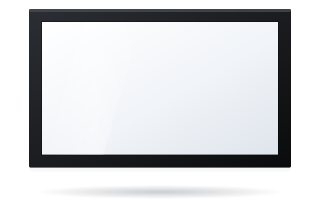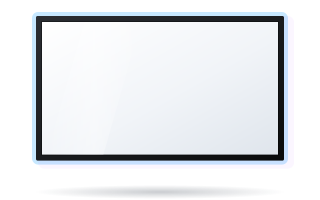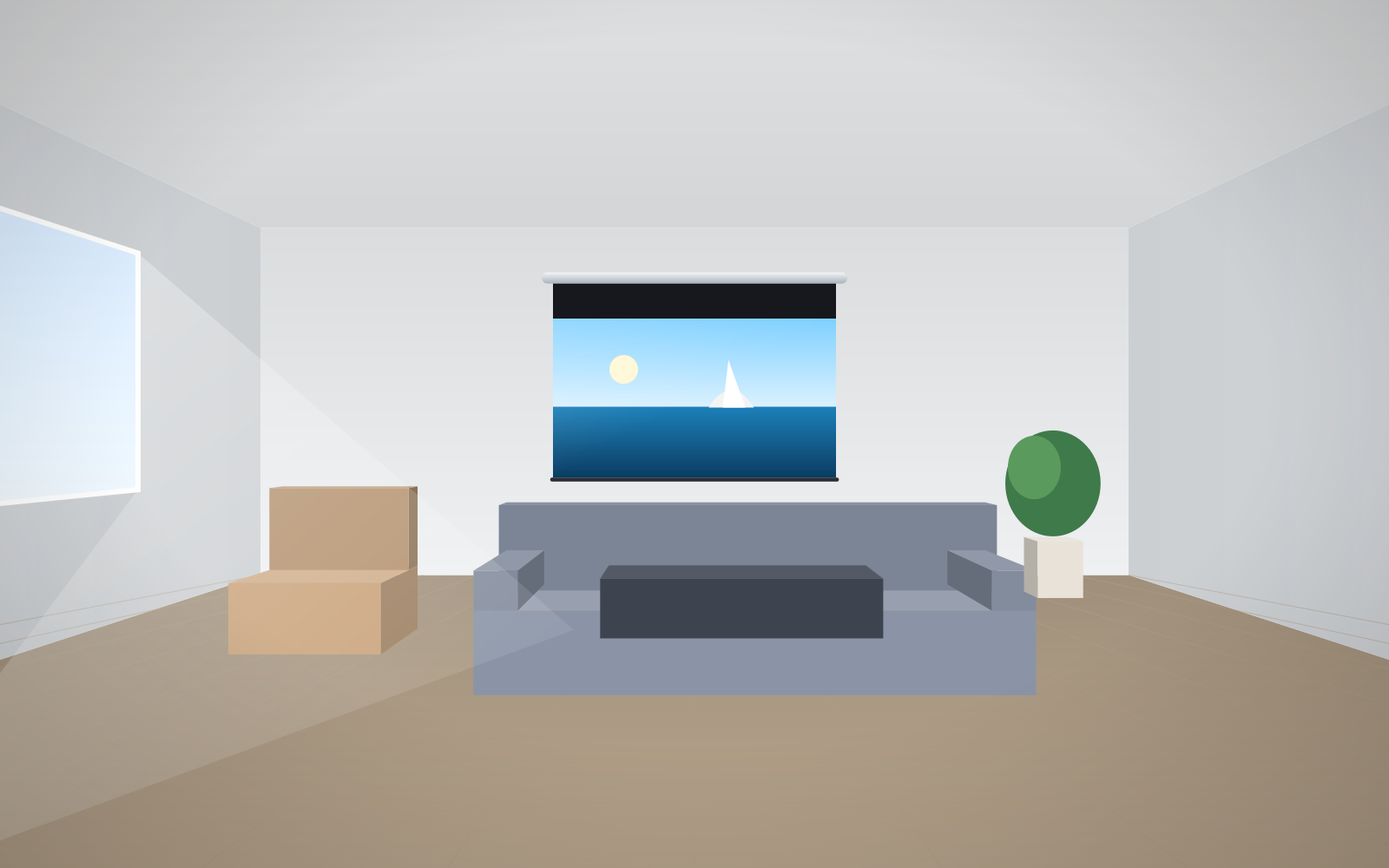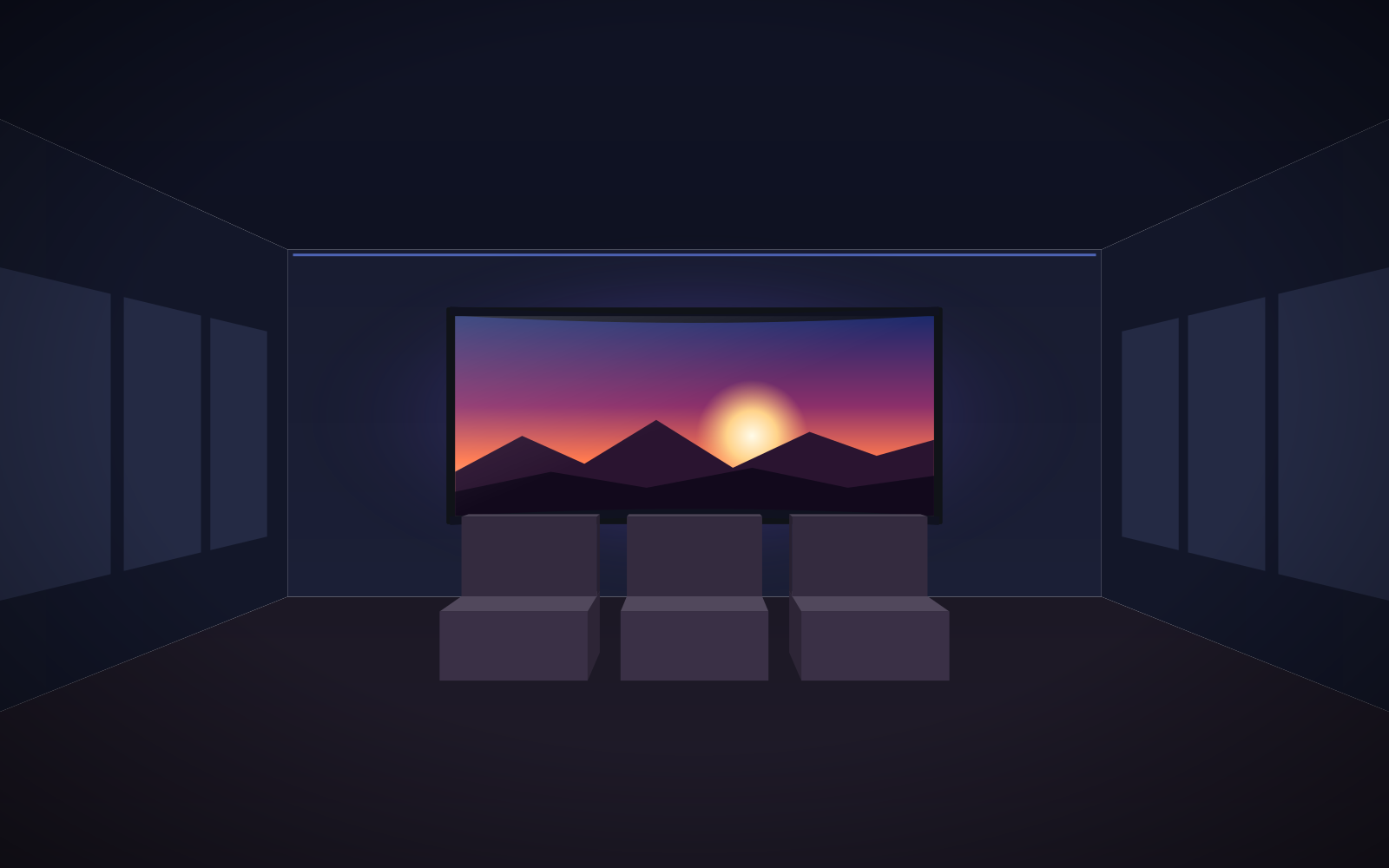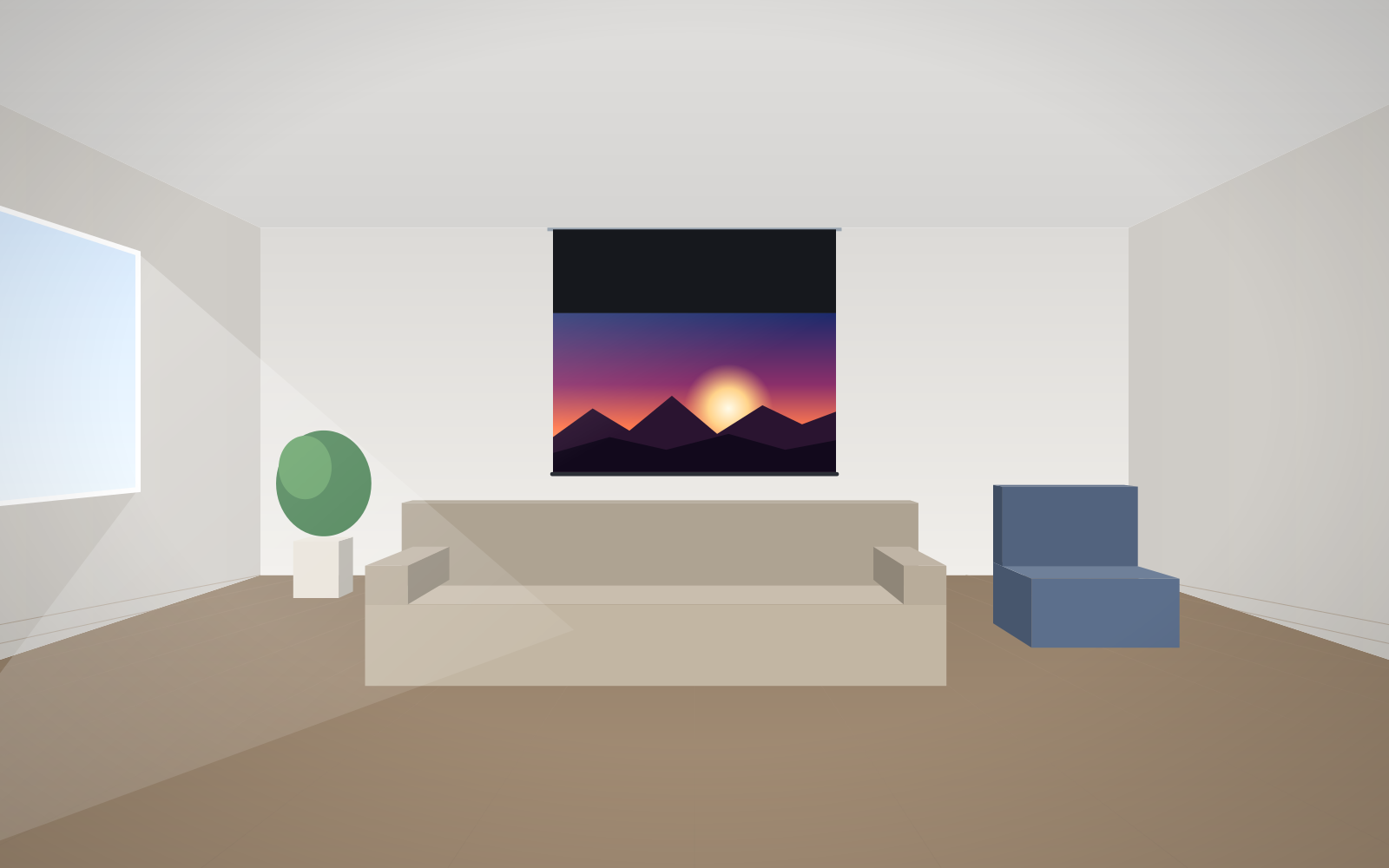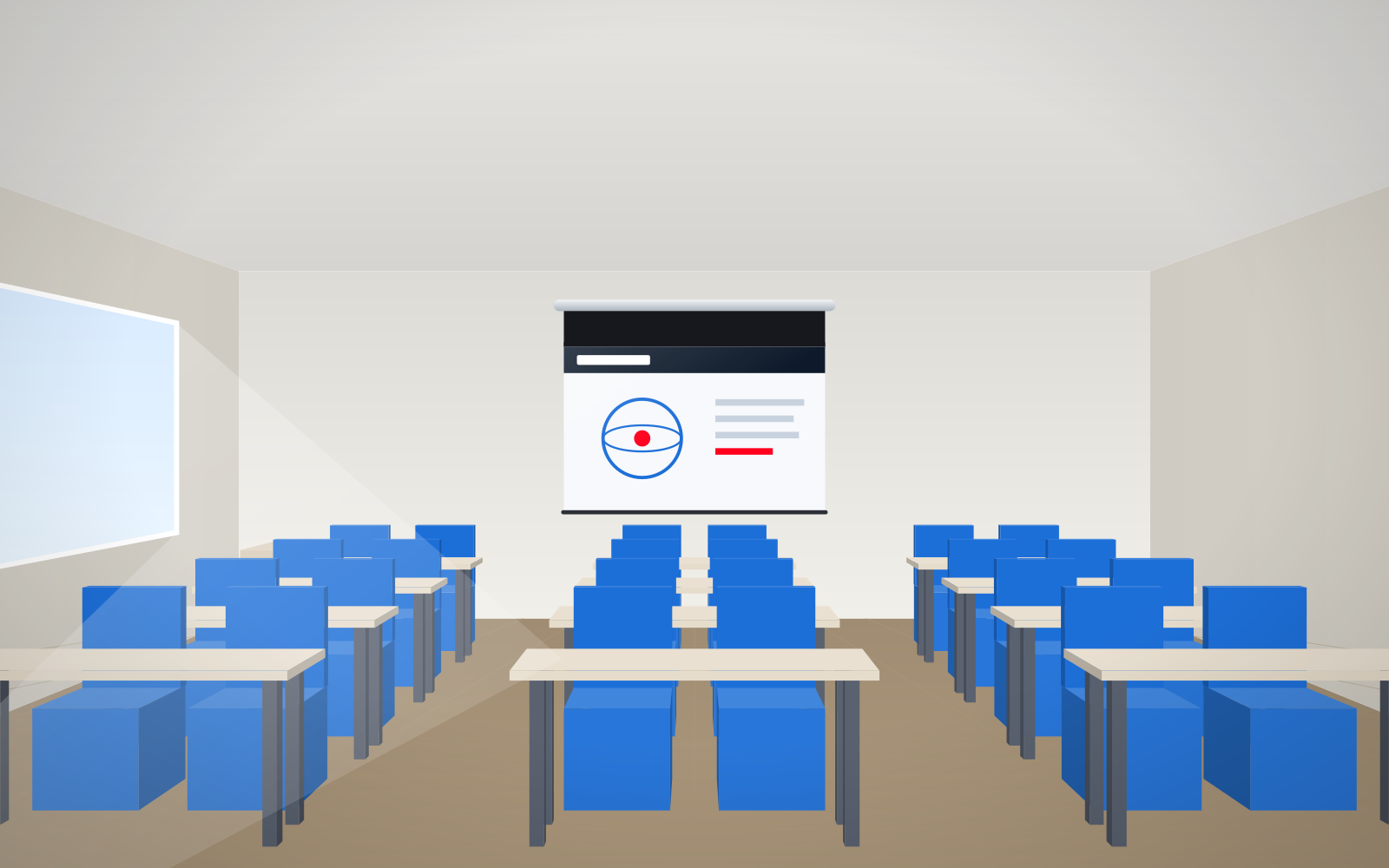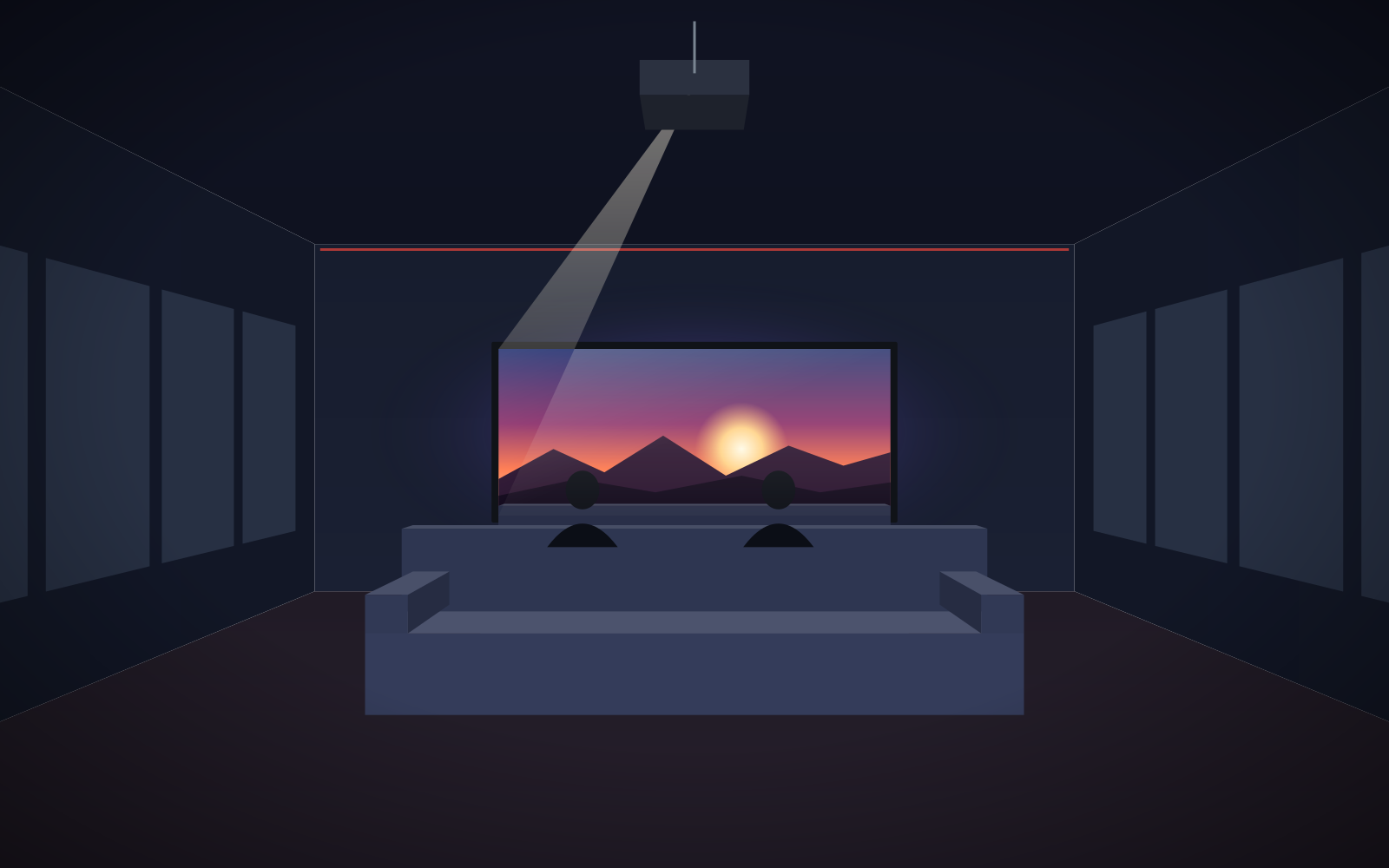
- A fixed-frame screen gives the flattest surface and works best in a dedicated cinema room.
- A motorised screen retracts into a case or the ceiling – the choice for living rooms, meeting rooms and multi-purpose spaces.
- UST projectors and ALR fabrics need a flat surface: a fixed-frame screen or a tensioned roller screen.
- A Tensio tensioned screen combines near-frame flatness with the ability to retract.
- You can compare prices of specific configurations in the configurator – they depend on model, size and fabric.
What the difference is
A fixed-frame screen is fabric stretched over a rigid frame and fixed to it with elastic cords. It hangs permanently on the wall, and the fabric is evenly tensioned in all directions. A motorised screen is fabric wound onto a roller in a case; a motor unrolls it downwards and a weight in the bottom bar straightens it. After use, the fabric returns to the case and the wall is clear.
Most of the other differences follow from this design difference: flatness, appearance, installation method, and which fabrics and projectors can safely be combined with a given screen.
Comparison table
| Feature | Fixed-frame screen | Motorised screen | Motorised with Tensio tensioning |
|---|---|---|---|
| Fabric flatness | best, no ripples | good; slight waves at the edges possible on large sizes | very good, close to a frame |
| Visibility when not in use | visible all the time | retracts into the case | retracts into the case |
| In-ceiling version | no | yes (Inceel) | yes (InSuperior, Max Inceel) |
| ALR fabrics | yes | not recommended without tensioning | yes |
| UST projector | yes, recommended | not recommended | yes |
| Acoustic fabrics | yes | on selected models | yes |
| Image surround | black velvet frame or invisible (Frameless) | optional black border on the fabric | black or white border on the fabric |
| Power and control | not needed | 230 V, switch, remote, trigger, room system | 230 V, as with a motorised screen |
| Installation | simple, wall brackets | wall or ceiling, cabling | wall, ceiling or recessed |
Flatness: why it matters so much
Any unevenness in the fabric changes the angle at which light is reflected towards the viewer. On a flat surface this is invisible, but when the fabric ripples, darker and lighter bands appear in bright scenes and when the image pans. The problem gets worse in three situations:
- a UST projector – light hits the screen at a very steep angle and accentuates every ripple,
- ALR fabric – its structure reflects light directionally, so unevenness is more visible,
- large sizes and 4K resolution – a larger fabric area and more detail in which distortions show.
ADEO roller screens come as standard with features that limit waviness: the fabric is fixed at the ends with two springs that compensate for its expansion, and the roller has a double groove that prevents horizontal marks. Even so, roller fabric is not tensioned sideways as it is on a frame. When flatness is critical, choose a frame or a Tensio tensioned screen.
Looks and space
In a dedicated cinema room a fixed-frame screen looks like part of the interior: the black velvet frame of the Plano absorbs light around the image and boosts perceived contrast, the narrow Prestige frame (approx. 10 mm) is discreet, and on the Frameless model the frame is invisible from the front, so the image looks as if it is hanging on the wall. In a living room, however, the same screen takes over the wall permanently – you can't hang pictures or shelves there, and a large light or black surface dominates the interior.
When rolled up, a motorised screen is just a case. The slim Linear SE case (approx. 79 × 118 mm) is barely noticeable, and the Inceel in-ceiling screen leaves only a narrow slot in a suspended ceiling. On many models the bottom bar closes the case when the screen is rolled up, protecting the fabric from dust.
Cost
We don't give prices here, because they depend on the model, image width, aspect ratio, fabric and finish – you can price any configuration instantly in the configurator. The general relationships are predictable, though:
- with a motorised screen you pay for the case, motor and control; with a fixed frame, for the frame and its finish,
- Tensio tensioning, in-ceiling installation and optional radio motors increase the cost of a roller screen,
- a fixed-frame screen needs no power supply or control cables, which simplifies installation.
Compare like with like in terms of flatness: with a UST projector or ALR fabric, the real alternative to a frame is a tensioned screen, not the simplest roller screen.
Ultra-short-throw projectors: a frame or Tensio
UST projectors, placed a few dozen centimetres from the wall, are very demanding on the screen. The manufacturer recommends a fixed-frame screen (Plano, Frameless, Prestige) or a tensioned roller screen, in both cases with Reference Grey 2 or Ambient Grey fabric. Ambient Grey 2 fabric is not suitable for UST. More in the guide screens for ultra-short-throw projectors.
Tensio as a compromise
Tensioned screens have side cables or the Floating Tab system, which tension the fabric horizontally while the weight bar tensions it vertically. The surface is as flat as on a frame, yet the screen still retracts into its case. This is the most common choice for living rooms with 4K and UST projectors and for prestigious meeting rooms. Examples: OnSuperior (case on the wall or below the ceiling), InSuperior (in-ceiling), Rugby Pro and Rugby Plus in the Tensio Classic version. The full list is in the tensioned screens category.
A third way: an in-ceiling screen
If the room has a suspended ceiling, a motorised screen can be hidden completely. The case is installed in the ceiling, and when the fabric is rolled up only a narrow slot is visible – in a living room or boardroom the interior looks as if there were no screen at all. ADEO in-ceiling screens come in a classic version (Inceel, also with Tensio Classic), with Floating Tab tensioning (InSuperior) and in a large-format version (Max Inceel). The recess must be planned with the ceiling contractor before the ceiling is built – we describe this in the guide in-ceiling screens.
And if the screen needs to be portable
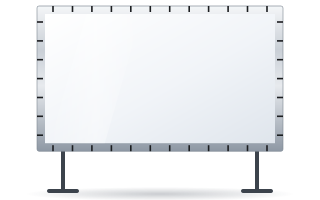
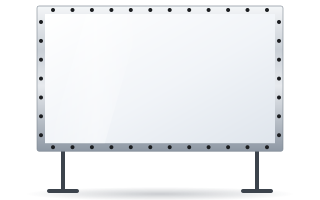
Neither a classic fixed-frame screen nor a motorised one is designed to be moved often. For events, off-site training and rental there are FramePro folding frames with fabric fixed by press studs or elastic cords, and quick-fold surfaces fixed to trusses. They fold down for transport and, once assembled, give a flat surface like a fixed-frame screen.
When to choose a fixed-frame screen
- You have a dedicated cinema room and the screen doesn't need to disappear.
- You use a UST projector or ALR fabric and want the simplest route to perfect flatness.
- You are planning a 2.35:1 cinema format or a curved screen (Plano Curved, Frameless Curved).
- You want to avoid running power to the screen.
- You need a portable screen – in that case, look at FramePro folding frames.
When to choose a motorised screen
- The screen hangs in a living room, bedroom or multi-purpose room and should disappear after use.
- The screen covers a window, whiteboard, bookcase or door.
- The room has a suspended ceiling and you want to hide the screen in it.
- The screen should come down automatically with the projector or from the room's control system.
- You need a very large image that can disappear – the largest roller screens, such as Big One, have an image width of up to 8.5 m.
Common mistakes
- The simplest roller screen for a UST projector – ripples in the fabric will be visible even with minor deformation.
- A fixed-frame screen in a living room without a free wall – after a few months it gets in the way and starts serving as a magnetic notice board.
- No cabling for a motorised screen – the 230 V supply and any control must be planned before the walls are finished. See installing a motorised screen.
- A fixed-frame ALR screen without checking the viewing angle – Ambient Grey 2 has an angle of approx. 60°, so a wide sofa and side armchairs need to fit within it.
Compare models in the fixed-frame screens and motorised screens categories, or configure a screen straight away in the configurator.
Frequently asked questions
Does a motorised screen ripple?
On larger sizes slight waves can appear at the edges of roller fabric, especially noticeable with UST projectors and ALR fabrics. The solution is Tensio or Floating Tab side tensioning, or a fixed-frame screen.
Which screen is better for home cinema?
For a dedicated cinema room – fixed-frame, because it gives the flattest surface and a black velvet frame. For a living room, a tensioned motorised screen that disappears after viewing is the more common choice.
Can a fixed-frame screen be hung in a living room?
Yes, but it occupies the wall permanently. It works well when the wall is used only for viewing anyway and there is a UST projector in the living room.
Which screen for a UST projector – fixed-frame or motorised?
Fixed-frame or a tensioned motorised screen, with Reference Grey 2 or Ambient Grey fabric. An ordinary roller screen and Ambient Grey 2 fabric are not recommended for UST.
Does a fixed-frame screen need power?
No. A fixed-frame screen hangs on wall brackets and has no motor, so it needs no cabling.